Grammar School vs Good Academy: The Honest 2026 Guide for Parents Who Aren't Sure
Not every child should sit the 11+. Not every child will be better off at a grammar school. Here's the data-driven, no-spin comparison — including the three questions to ask before your child does a single practice paper.
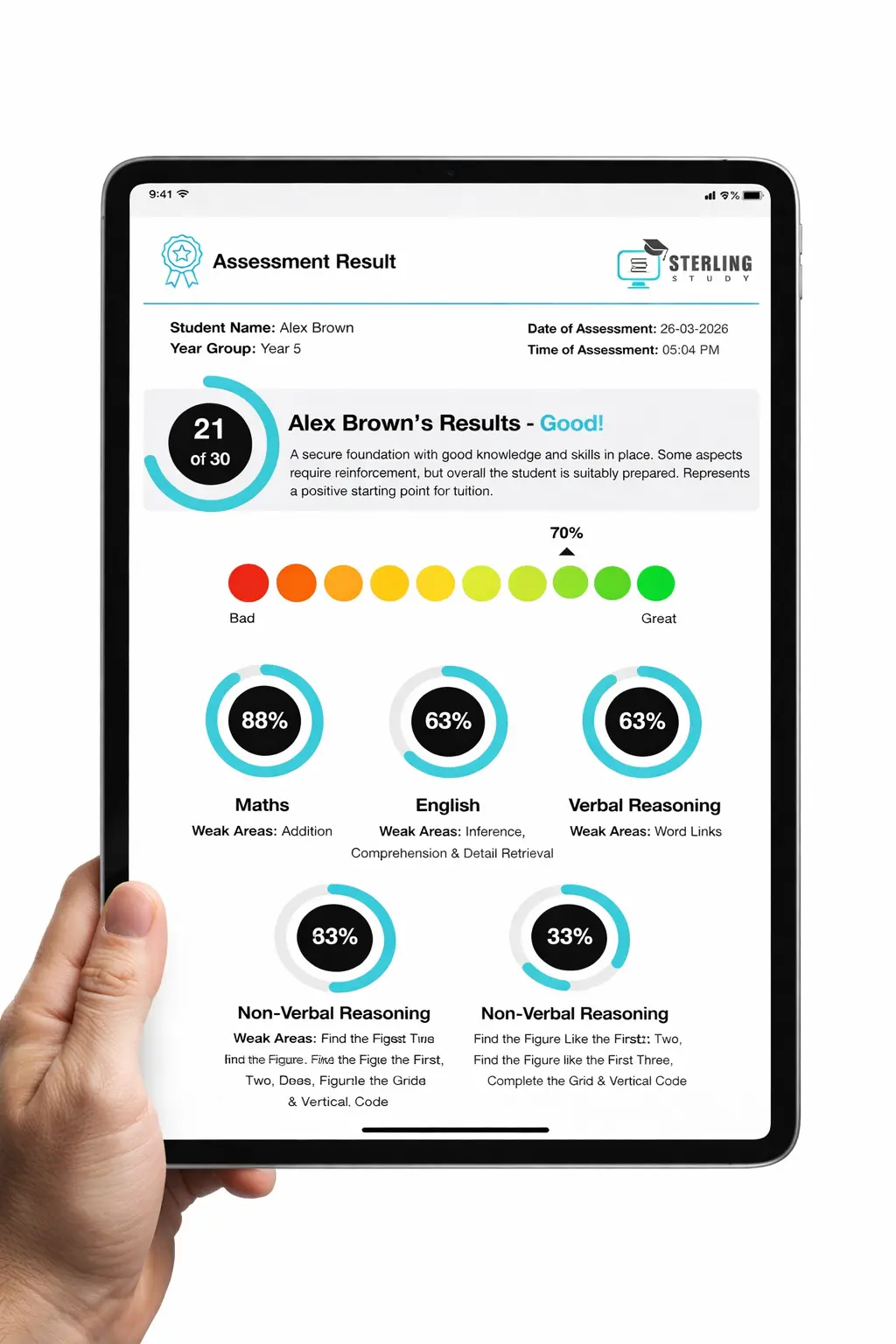
Not sure if grammar school is realistic for your child? Book a free diagnostic — our team will give you an honest read of where your child stands →
I run an 11+ preparation programme. Before you read another word of this guide, I want to be direct: not every child should sit the 11+. Not every child will thrive more at a grammar school than at a strong academy. This guide is for parents who are genuinely thinking it through — who want honest data rather than a sales pitch in either direction.
Fix them.
For free.
- ✓ Subject-by-subject breakdown across all Science topics
- ✓ Time-per-question analysis
- ✓ Where you stand vs grade boundaries
- ✓ Detailed PDF results sent immediately
- ✓ No strings attached
1. The Honest Starting Point
Parents who approach the 11+ as though a grammar school place is the only acceptable outcome often cause real harm — harm to their children during a preparation period that should build confidence, not corrode it. Harm to family relationships over eighteen months of pressure. And sometimes lasting harm to a child's relationship with academic work altogether, when the environment they end up in is wrong for how their brain works.
The most thorough comparison of grammar schools and strong academies available for 2026. Attainment data, psychological research, wellbeing evidence, the 11+ process itself, and a practical framework for making the right call for your specific child.
2. What Is a Grammar School in 2026?
A grammar school is a state-funded secondary school that selects its pupils entirely or primarily on academic ability, assessed through the 11+ examination taken at the end of Year 6. England has 163 grammar schools as of 2025, concentrated in Kent, Buckinghamshire, Lincolnshire, Trafford, and parts of the West Midlands, Essex, and Hertfordshire.
A grammar school in a highly selective area with a long waiting list is a very different proposition from one in a less pressured area where the pass mark is lower. Their quality spans a wide range.
3. What Is a Good Academy in 2026?
An academy is a state-funded school operating with greater independence from the local authority. The word "academy" does not in itself tell you much about quality. The relevant comparison is not "grammar school vs any academy" but "grammar school vs a strong, Ofsted Outstanding academy in the same area."
Many strong academies now have dedicated scholarship programmes, Oxbridge preparation support, and enrichment activities that were once the exclusive domain of grammar schools. The gap that existed ten years ago has narrowed significantly at the top end of the non-selective state sector.
4. Grammar School vs Good Academy: The Full Comparison
| Factor | Grammar School | Strong Ofsted Outstanding Academy |
|---|---|---|
| Admissions | Selective by academic ability (11+) | Catchment, siblings, faith criteria in most cases |
| Teaching pace | Fast, assumes high ability across the cohort | Differentiated; top sets move at pace comparable to grammar |
| Peer environment | All students selected for academic ability | Mixed ability; high attainers are a minority |
| Relative peer position | Your child may be average or below average | Your child is more likely to be at or near the top |
| GCSE outcomes | Consistently above national average | Strong schools match or approach grammar GCSE outcomes |
| A-Level provision | Typically strong, competitive sixth form | Varies significantly; must be researched per school |
| Russell Group progression | Higher on national average | Comparable for high-attaining top-set students |
| Learning differences support | Variable; some schools less well-equipped | Often broader SEN and EAL provision |
| Social diversity | Limited by selection; less socially diverse | Reflects the local community more broadly |
| Cost of access | 11+ preparation costs; no tuition fees | No 11+ costs; no tuition fees |
| Best suited to | Intrinsically motivated, academically confident students | Wide range, including students who would be mid-cohort at grammar |
5. What the Research Actually Says
The debate about grammar schools is politically charged, which means many claims made in public discourse are shaped more by ideology than evidence. Here is what the peer-reviewed research actually shows.
The Institute for Fiscal Studies Analysis
The most comprehensive analysis found that the biggest beneficiaries of grammar school entry are students who sit near the borderline of selection — bright but not exceptional students who would have been in the top third of a comprehensive cohort. Students in roughly the top five percent of the ability range tend to achieve strong outcomes regardless of school type.
Grammar schools disproportionately serve students from higher socioeconomic backgrounds. FSM-eligible students are significantly underrepresented in grammar school cohorts relative to their share of the local population — confirmed in multiple Sutton Trust analyses.
When rigorous methods controlling for prior attainment and socioeconomic background are applied, the raw difference in outcomes between grammar schools and strong non-selective schools for high-attaining students narrows considerably.
6. The Big Fish, Small Pond Effect Explained
One of the most robust findings in educational psychology is the "big fish, small pond effect", coined by researcher Herbert Marsh and replicated across dozens of countries. A student's academic self-concept is shaped not just by their objective performance but by how they perform relative to their immediate peer group.
This does not mean grammar school is wrong for students who will be in the bottom half of the cohort. Some students are genuinely better served by the pace and environment even if their relative position is lower. But the instinct that "grammar school is better, therefore my child should go to grammar school" is too simple by a significant margin.
7. Grammar Schools and Academies: GCSE & A-Level Performance
Do not compare a grammar school with the national average for non-selective schools. Compare it with the specific academy you are considering. Request the Progress 8 score, A-Level value-added data, and the percentage of students progressing to Russell Group universities. Then make the comparison properly.
At national level, grammar schools produce higher average GCSE outcomes than non-selective state schools. This is not surprising — they select students already likely to achieve higher. When the comparison is made for similar students, research from the Education Policy Institute suggests the advantage, while real, is modest for students who would have been high-attaining regardless.
8. Russell Group Entry: Does School Type Really Matter?
Grammar school students are statistically more likely to attend Russell Group universities than students at non-selective state schools. This is accurate in aggregate — but it does not prove causation. Grammar schools select students who already have the academic profile for selective university success.
For a high-attaining student choosing between a grammar school and an Ofsted Outstanding academy with strong sixth form data, the university outcome will depend far more on: the student's own motivation and work ethic; the quality of A-Level teaching in their specific subject choices; and the school's UCAS support and personal statement guidance.
9. Three Questions to Ask Before Your Child Sits a Single Paper
These are worth sitting down as a family and actually answering — before a single practice paper is attempted, before a single tutor session is booked, and before the school visit calendar is filled with grammar school open days.
10. How to Assess Your Child's Realistic Grammar School Chances
11. What Happens If Your Child Narrowly Misses a Grammar Place?
A near-miss on the 11+ is genuinely disappointing. Most grammar schools have a formal appeal process for borderline candidates — appeals are more likely to succeed with evidenced extenuating circumstances such as illness, bereavement, or administrative error.
"We started the process assuming grammar school was the only option. Our son didn't get in. Through the preparation we found a brilliant academy with a specialist maths programme. He's thriving there. I'm actually glad we had to look harder."
— David K., Sterling Study parent
The preparation your child undertook for the 11+ has value regardless of the outcome. The study habits, the confidence with verbal and non-verbal reasoning, the ability to work under time pressure: these do not disappear because the exam result was not what you hoped.
12. The Emotional & Wellbeing Dimension Parents Rarely Discuss
For children who are more emotionally sensitive, less intrinsically motivated, or who are responding primarily to parental expectation, the preparation period can be experienced as a sustained source of anxiety — manifesting in sleep disruption, resistance to practice sessions, and a growing association between academic work and stress.
Research found that grammar school students report higher levels of academic pressure and exam anxiety than students at comparable non-selective schools. This does not mean grammar school is harmful — it means the environment is more academically pressured, which comes with an emotional cost that should be factored into the decision.
When visiting grammar schools, ask specifically about how the school supports students who are finding the academic pace challenging. Ask what pastoral support looks like. The quality of the answers tells you a great deal.
13. A Step-by-Step Decision Framework
14. Frequently Asked Questions
15. Final Verdict: Which Is Better for Your Child?
There is no universal answer. Anyone who tells you otherwise is selling something. Here is the honest summary of what the evidence supports.
🏫 Grammar school is likely better if...
- Your child is genuinely enthusiastic about the academic environment
- They perform well under time pressure
- They are in the top 15% of the academic ability range, based on objective assessment
- The target grammar school has strong data and a pastoral culture you are comfortable with
- Your family has a genuine, comfortable Plan B in place
🏛 A strong academy is likely better if...
- Your child would be in the bottom quarter of a grammar school cohort
- They are sensitive to pressure or competitive comparison
- They have specific learning differences the grammar school is poorly equipped to support
- The local academy has demonstrably strong data for high-attaining students
- Your child has genuine enthusiasm for the academy's specialist provision
Make this decision based on the child you actually have, with objective data about both schools, and with your child's own views treated as real input rather than something to be managed. The preparation process for the 11+ is valuable regardless of the outcome — it builds reasoning skills, study habits, and the ability to work under assessment conditions. None of that is wasted if the result is not a grammar school place.