11+ Verbal Reasoning: Why Practice Papers Aren't Moving Your Child's Score
Your child is doing VR papers every weekend. The scores aren't moving. Here's the real reason — and the specific, teachable technique that reliably unlocks 15 to 20 percentage point improvements.
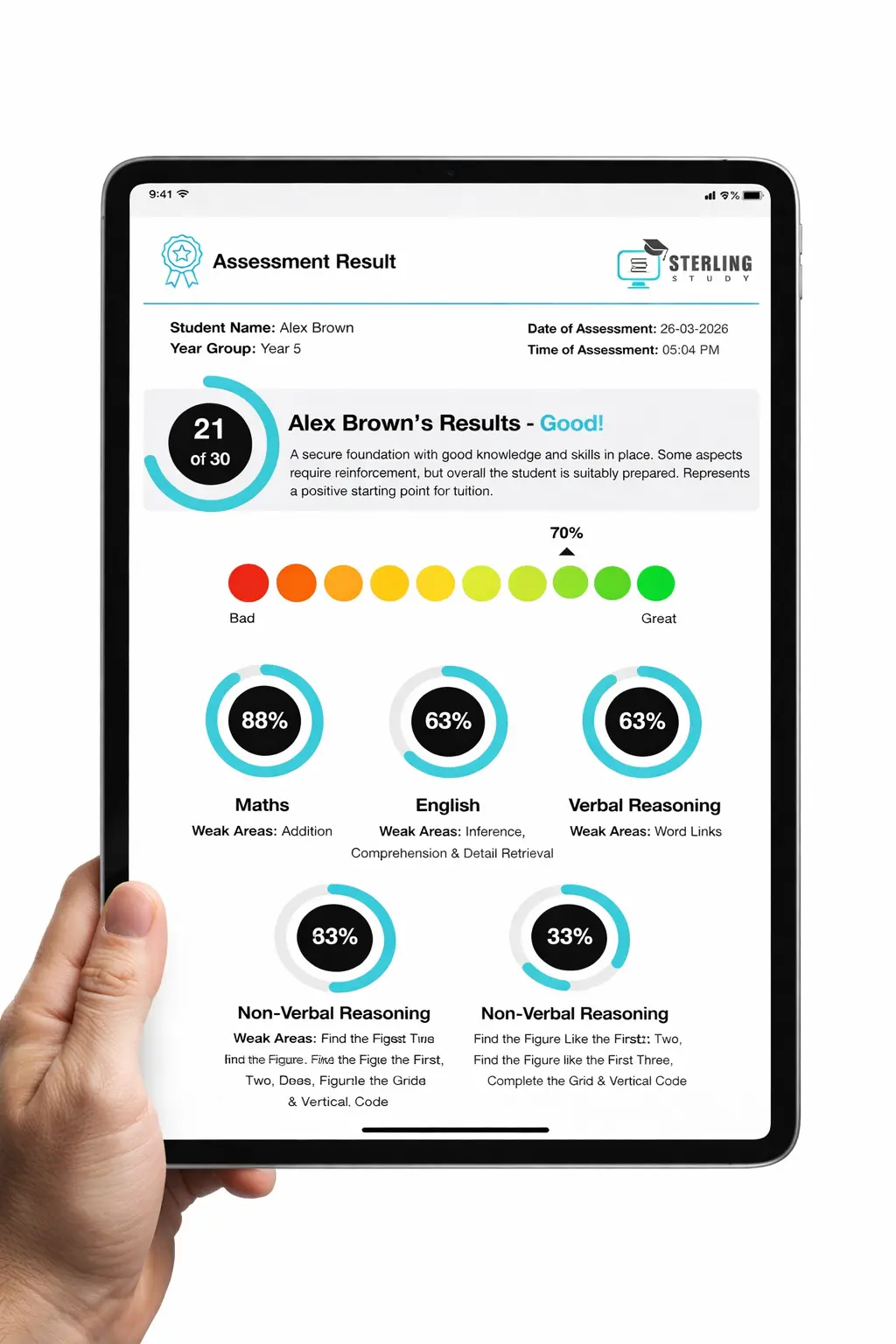
Not sure where your child's gaps are? Book a free 11+ diagnostic — our expert team will find exactly what's holding them back →
Every Saturday for three months. An hour of verbal reasoning papers. Scores go from 54% to... 57%. The child is not lazy. The papers are pitched at the right level. The parents are committed and involved. And yet nothing is moving. The answer is straightforward once you see it: practising papers without first learning the underlying question types is practising confusion, not building skill.
Fix them.
For free.
- ✓ Subject-by-subject breakdown across all Science topics
- ✓ Time-per-question analysis
- ✓ Where you stand vs grade boundaries
- ✓ Detailed PDF results sent immediately
- ✓ No strings attached
1. The Most Frustrating Pattern in 11+ Preparation
Every week, the child sits down, encounters the same formats they half-recognise, makes the same pattern of mistakes, finishes in roughly the same time, and achieves roughly the same score. The paper has not taught them anything new because there was nothing new to learn. They simply repeated the same partially-formed responses to questions they never properly understood in the first place.
Children who practise papers without learning question-type strategies are practising the wrong thing. More papers will not fix a method problem. The breakthrough is almost always the same: structured type-by-type instruction replaces unstructured paper repetition, and the score begins moving almost immediately.
GL Assessment verbal reasoning papers are structured tests of pattern recognition applied to language. The test checks whether a child can identify patterns within and between words, apply consistent logical rules to unfamiliar inputs, decode coded letter or number sequences, and do all of this quickly under timed conditions. None of these skills are purely natural or innate — each one is trainable, but they require specific, deliberate instruction aimed at each question type individually.
GL Assessment vs CSSE VR: Know Which Exam You Are Preparing For
| Feature | GL Assessment VR | CSSE VR |
|---|---|---|
| Number of question types | Up to 21 distinct types | Fewer discrete types |
| Question format | Short, format-specific questions | Longer comprehension-style passages |
| Timing pressure | High — short answer windows | Moderate — longer reading tasks |
| Key skill emphasis | Pattern recognition at speed | Extended comprehension plus VR |
| Primary preparation focus | Type-by-type strategy mastery | Reading + embedded VR skills |
| Schools using this format | Most grammar and selective independent schools | Essex consortium grammar schools |
Preparing for the wrong format is one of the most common and easily avoidable preparation errors. Always confirm which exam board your target school uses before designing a preparation programme.
2. The 21 GL Assessment VR Question Types: A Complete Reference
GL Assessment VR papers contain up to 21 question types across any given paper. Understanding each type in isolation, before attempting mixed papers, is the single most important structural shift in how most children prepare. Below is a priority-ranked reference of the most commonly tested types.
| VR Question Type | What It Tests | Example Format | Priority |
|---|---|---|---|
| Word synonyms / closest meaning | Vocabulary breadth and precision | Which word means the same as RAPID? | HIGH |
| Letter codes / substitution | Alphabetic logic and code decoding | If CAT = 312, what does ACT = ? | HIGH |
| Word analogies | Relational reasoning between word pairs | Warm is to Hot as Dim is to ? | HIGH |
| Letter sequences | Pattern recognition in alphabetic series | AZ, BY, CX, DW, __? | HIGH |
| Odd one out | Categorical reasoning and classification | Which word does not belong? | HIGH |
| Move a letter | Structural word manipulation | Move one letter from first word to second word | HIGH |
| Missing word | Contextual vocabulary and inference | Find the word that completes both sentences | HIGH |
| Hidden words | Word-within-word spotting across boundaries | Find a 4-letter word hidden across two words | MEDIUM |
| Number sequences | Numerical logic embedded in VR format | 3, 6, 12, 24, __? | MEDIUM |
| Letter-number links | Cross-modal alphabetic-numeric reasoning | A=1, B=2... what letter is 5 × 3? | MEDIUM |
| Compound words | Word-building and vocabulary | Join two words to make one longer word | MEDIUM |
| Word connections | Semantic grouping | Find two words (one from each group) that go together | MEDIUM |
| Anagrams | Letter manipulation and vocabulary | Rearrange these letters to make a word | LOWER |
| Antonyms | Vocabulary and conceptual opposites | Find the word most opposite in meaning to BRAVE | LOWER |
| Reorder letters | Pattern and word-building | What word can be made from these letters? | LOWER |
When a child can look at a question and instantly label it — 'that's a letter code' or 'that's a word analogy' — they are no longer wasting 20 to 30 seconds orienting themselves. In a timed exam, this recognition speed advantage compounds across every question in the paper.
3. The Three Root Causes of VR Score Stagnation
The Vocabulary Crisis: Deeper Analysis
Children need confident understanding of approximately 2,500 to 3,500 word families beyond basic everyday vocabulary to perform reliably at the top end of the VR mark range. The vocabulary clusters that appear most frequently in GL VR papers include emotional and psychological states (reluctant, melancholy, apprehensive), physical states and movement (ascending, vigorous, lethargic), character and personality (courageous, obstinate, amiable), environmental description (tranquil, desolate, abundant), and temporal terms (subsequent, simultaneous, imminent).
4. The Complete Five-Phase VR Practice System
The following practice system is the exact sequence we use at Sterling Study for every 11+ VR student. It is designed to build skill in the correct order: understanding before accuracy, accuracy before speed, type-specific before mixed format. Skipping phases, or compressing them to save time, is the primary reason children plateau.
| Phase | What to Do | Time Allocation | When to Progress |
|---|---|---|---|
| Phase 1: Learn the Type | Study the format and solving strategy for one question type only. No timing. No mixed questions. | 1–2 sessions per question type | Child can explain the strategy in their own words without prompting |
| Phase 2: Untimed Accuracy | Practise 10–15 questions of that same type only. No time pressure. Focus entirely on correct strategy. | Until 80% accuracy is achieved consistently | 80% or higher accuracy on three consecutive sets |
| Phase 3: Timed Single-Type | Same type with gentle time pressure. Start at 1.5× target exam pace and gradually reduce. | 5–7 sessions | Working within 20% of target exam pace without losing accuracy |
| Phase 4: Mixed Untimed | 3–5 mastered question types mixed together without time pressure. Child must identify the type before solving. | 4–6 sessions | Accuracy across all included types is 75%+ with correct type identification |
| Phase 5: Mixed Timed | Full paper conditions. All question types. Exam timing. Mark and review every error by type. | Final 4–8 weeks | This is the end state; refine based on error patterns |
Treating a timed mixed paper as a teaching tool. It is not. It is a test. Teaching happens before the test, not during it. A child who reviews errors by type learns approximately three times more from each practice session than a child who simply marks their paper and moves on.
Letter Sequences: The High-Value Type Most Children Get Wrong
Letter sequence questions present a series of letter patterns (typically two-letter pairs) and ask the child to identify the next pair. The correct approach is always to analyse each position independently. Look at what all the first letters are doing across the sequence, then look at what all the second letters are doing, then combine the two rules to generate the next pair.
Example: AZ, BY, CX, DW — what comes next? Position 1 (A, B, C, D) moves forward one step each time: next is E. Position 2 (Z, Y, X, W) moves backward one step each time: next is V. Answer: EV. Children trained to separate the positions solve these reliably within 20 seconds.
Word Analogies: The Seven Core Relationship Types
Training children to recognise these seven relationship types covers the vast majority of analogy questions in GL Assessment papers: part to whole, degree or intensity, function or purpose, cause to effect, category membership, synonym or antonym relationship, and transformation. When a child encounters an analogy question, their first step should always be to name the relationship type — naming forces precision and eliminates guessing based on loose thematic association.
5. Common Mistakes to Avoid
Frequently Asked Questions